Chapter 1 of 20
Chapter 1: Youth and Humble Pastoral Life in Cyprus
Saint Spyridon was born at the end of the 3rd century on the blessed Mediterranean island of Cyprus, during the era of severe persecutions under Emperor Diocletian. Being the son of simple peasants, he tended sheep from his earliest years. Lacking secular formal education, the youth was taught directly by the Holy Spirit, distinguishing himself by wondrous gentleness, purity of heart, and deep love for the poor. He married a pious maiden and was blessed with children, but soon his wife fell asleep in the Lord. The righteous man met this sorrow with steadfast humility, dedicating his life, labor, and earthly goods ever more fervently to the service of the oppressed and the destitute.
Chapter 2 of 20
Chapter 2: Elevation to the Episcopal See of Trimythous
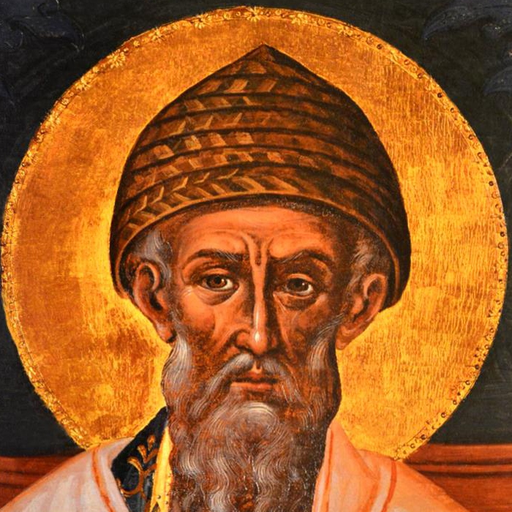
When the local archpastor of the Cypriot city of Trimythous reposed in the Lord, the clergy and the entire faithful populace unanimously desired Spyridon to become their bishop. After donning the episcopal omophorion, the holy hierarch did not alter his humble way of living: he continued wearing a rough hairshirt and a modest shepherd's cap woven from willow reeds (the miter of simplicity), while continuing to herd his sheep with his own hands. His home remained open day and night to every traveler, orphan, and widow.
Chapter 3 of 20
Chapter 3: Triumph at the First Ecumenical Council (325 AD) and the Miracle of the Brick
At the First Ecumenical Council in Nicaea, the proud heretic philosopher Arius attempted to deny the eternal Divinity of the Son of God using human sophistry and rhetoric. Seeing how the heretics were confusing the people, Saint Spyridon stepped forward holding a common clay brick (plinth) in his hand. Speaking of the Holy Trinity, he squeezed the brick: fire flashed upward into the sky, water flowed downward onto the floor, while dry clay remained in his palm. 'Lo, one brick, yet three elements: fire, water, and earth. Even so in the Holy Trinity: Three Persons, yet One Divine Essence,' declared the saint. Struck with awe at this miraculous sign, the philosopher renounced his heresy and embraced the true Orthodox faith.
Chapter 4 of 20
Chapter 4: Turning a Serpent into Gold to Deliver a Debtor
During a severe famine, an impoverished farmer came in utter desperation to the holy hierarch: a cruel merchant refused to lend him grain to feed his starving children without collateral. Saint Spyridon prayed, took a living serpent crawling in the garden, and made the sign of the cross over it — instantly the serpent hardened into a solid bar of pure gold. The poor man brought the gold to the creditor, fed his family, and after the harvest redeemed the pledge and returned it to the saint. Spyridon placed the gold bar upon the ground, gave thanks to God, and the gold instantly came alive, turned into a serpent again, and slithered away into the brush.
Chapter 5 of 20
Chapter 5: Prayer for Rain During a Deadly Drought
When Cyprus suffered for over a year under a merciless scorching drought, crops burned, and thousands of people were perishing from starvation and disease, Saint Spyridon fell on his knees in tears before the holy altar. Like the holy Prophet Elias of old, he prayed for the mercy of God. Suddenly the sky became covered with dark clouds, and a bountiful, grace-filled rain descended upon the parched earth, lasting for several days and saving the entire island from catastrophe.
Chapter 6 of 20
Chapter 6: Singing of Invisible Angels During the Divine Liturgy
Once, the holy hierarch was serving the Divine Liturgy in an almost empty temple, where only a deacon and an acolyte were present. When the bishop exclaimed, 'Peace be unto all!', an otherworldly, breathtakingly beautiful choir of hundreds of heavenly voices resounded from the altar and beneath the high church dome, chanting: 'And to your spirit! Lord, have mercy!' The inhabitants of the town, hearing the heavenly singing, ran to the church in amazement, but upon entering found only the elderly bishop with divine light radiating from the holy altar.
Chapter 7 of 20
Chapter 7: Healing of the Mortally Ill Emperor Constantius
When the son of Emperor Constantine fell gravely ill in Antioch, no physician in the empire could cure him. In a vision, an angel revealed to the sovereign the image of the humble Cypriot bishop. Saint Spyridon arrived at the palace dressed in humble rags; the palace guards struck him, mistaking him for a beggar, but the saint meekly turned the other cheek according to the Gospel. Entering the bedchamber, he merely touched the emperor's forehead — and the illness instantly departed. When the grateful emperor offered immense treasures, Saint Spyridon immediately commanded them all to be distributed to the destitute of Antioch.
Chapter 8 of 20
Chapter 8: Raising His Daughter Irene to Return a Deposit
The saint's pious daughter, Irene, passed away unexpectedly. Soon after, a weeping woman came to the bishop: she had entrusted all her family jewelry and valuables to Irene for safekeeping before her death, and no one knew where they were hidden. Saint Spyridon walked to his daughter's grave, called her by name — and the deceased daughter answered from the tomb, clearly explaining the exact hiding place in the house where the treasure lay. Having returned the valuables to the widow, the saint said: 'Rest in peace until the general resurrection of the dead,' and the maiden's soul departed peacefully to the Lord once more.
Chapter 9 of 20
Chapter 9: Resurrecting the Deceased Child of a Pagan Woman
A pagan woman who spoke no Greek brought her infant, who had died of disease, and laid the child at the saint's feet. Her bitter weeping and grief were so profound that the holy hierarch wept with her. Praying to Christ our God, he touched the infant — and the child opened its eyes and cried aloud! Overwhelmed by joy, the mother collapsed and died instantly of heart shock. Then the saint turned again to the Lord, commanding: 'Arise and take up your child!' — and restored the mother back to life as well.
Chapter 10 of 20
Chapter 10: Halting the Raging Waters of the River
Hurrying to court to save his close friend from an unjust execution caused by slander, Saint Spyridon encountered a raging, swollen river that had swept away the bridge. Like Joshua at the Jordan, the holy bishop commanded the waters: 'In the name of the Lord Jesus Christ, I command you to stand still so that I may cross!' The waters parted, forming a dry path, and the saint crossed over, arrived in time at the tribunal, and proved the total innocence of his condemned friend.
Chapter 11 of 20
Chapter 11: Gentleness Toward Night Thieves
One night, robbers sneaked into the saint's sheepfold to steal his sheep, but an unseen divine power bound them firmly in place, leaving them immobilized until dawn. In the morning, Saint Spyridon found them, prayed to free them from the invisible bonds, gently admonished them for their sin, and... presented them with a ram as a gift, saying with a kind smile: 'Take this, so that your sleepless labor of the night was not in vain, but go and sin no more.'
Chapter 12 of 20
Chapter 12: Blessed Repose of the Holy Hierarch
Having attained a venerable old age (around the year 348 AD), Saint Spyridon was forewarned of the exact day of his departure to the Lord. His final words to his flock were testamentary exhortations of love for God and neighbor, compassionate care for the poor, and steadfast preservation of the purity of the Orthodox faith. His peaceful repose was accompanied by a heavenly fragrance and the quiet sorrow of thousands of faithful whom he had fathered in Christ.
Chapter 13 of 20
Chapter 13: Incorrupt Relics and Translation to Corfu (Kerkyra)
After the fall of Constantinople in 1453, a Greek priest named Georgios Kalocharetis secretly translated the incorrupt relics of Saint Spyridon to the island of Corfu. For more than five centuries, they have rested in a silver reliquary inside the Saint Spyridon Church in Kerkyra. The body of the saint remains fully preserved, possessing natural soft tissue elasticity and maintaining the constant warmth of a living human body (36.6°C), baffling modern physicians and scientists.
Chapter 14 of 20
Chapter 14: The Miracle of the Worn Velvet Slippers
The most touching testimony to the living presence of the saint is that his embroidered velvet slippers wear out every single year as if he had been walking miles on rough ground. Cathedral priests often find that the silver key cannot turn in the lock of his reliquary, saying: 'Saint Spyridon is away walking the earth to comfort those who weep.' Each year on his feast day (December 12/25), the saint is dressed in new slippers, while the worn ones are reverently cut into tiny fragments and gifted to pilgrims as sacred blessings.
Chapter 15 of 20
Chapter 15: Deliverance of Corfu from the Ottoman Siege (1716)
In the summer of 1716, a 50,000-strong Ottoman army laid siege to the fortress of Corfu. The Venetian defenders and Greek militia were facing catastrophic defeat, and the fall of the island seemed inevitable. The inhabitants prayed unceasingly before the reliquary of Saint Spyridon. On the night of August 11, a violent tempest and torrential downpour broke out, and the Turks beheld an awe-inspiring white-bearded elder in monastic garb, brandishing a flaming sword and leading a host of radiant heavenly warriors. Overwhelmed by panic, the invaders abandoned weapons and cannons and fled to their ships. The Venetian Senate placed a silver vigil lamp in the church, and August 11 became an annual day of solemn litany.
Chapter 16 of 20
Chapter 16: Deliverance of the Island from the Deadly Plague (1629 & 1673)
Twice in the 17th century, bubonic plague threatened to annihilate the entire population of Corfu. When medicine was powerless, the people carried the holy reliquary through the streets in procession. According to historical municipal chronicles, during the litany sick victims who touched the saint's vestments recovered immediately. For several nights, a supernatural pillar of heavenly light stood above the church belfry, dispelling the infectious air and ending the pestilence completely.
Chapter 17 of 20
Chapter 17: Patristic Theology: Holy Simplicity vs. Intellectual Sophistry
In Orthodox patristic tradition, Saint Spyridon stands side by side with Saint Nicholas of Myra. Neither left behind voluminous theological treaties or philosophical treatises, yet their living communion with God defended the Church against the deadliest heresy of Arianism. Saint Spyridon demonstrated a foundational truth of Eastern Christian theology: God is not comprehended through intellectual syllogisms, but through a pure heart, unceasing prayer, and active sacrificial love for the poor. His 'theology of holy action' remains a supreme exemplar of Christian mystical realism.
Chapter 18 of 20
Chapter 18: The Sacred Meaning of the Shepherd's Cap (Miter of Simplicity)
In canonical iconography, Saint Spyridon is depicted not with a gold-embroidered jeweled episcopal crown, but with a humble rounded cap woven of willow twigs or sheep wool. This iconographic detail reminds every believer that before God, external ecclesiastical splendor is nothing compared to pastoral sacrifice. A shepherd watches over each sheep, knows its name, and protects it from wolves at the price of his own comfort — and thus Saint Spyridon watches faithfully over every soul that calls upon his aid.
Chapter 19 of 20
Chapter 19: Miraculous Rescue of Corfu Sailors in the Ionian Sea
Sailors and fishermen of the Ionian Islands venerate Saint Spyridon as their first heavenly protector on stormy seas. Numerous maritime records document ships that were sinking during catastrophic Mediterranean storms, when crew members suddenly beheld the luminous figure of the elder at the helm or atop the mast, guiding the vessel through jagged reefs into calm harbor. In gratitude, mariners brought silver votive ships to the church, which grace the sanctuary to this day.
Chapter 20 of 20
Chapter 20: The Spiritual Tradition of the 40-Day Akathist Rule
The number forty has profound biblical roots: Christ fasted forty days in the wilderness, Moses remained on Mount Sinai for forty days, and Nineveh was granted forty days for repentance. In Orthodox pastoral practice, praying the Akathist to Saint Spyridon for 40 consecutive days is a school of patience, spiritual constancy, and steadfast trust in divine Providence. A person who dedicates 25 minutes daily to prayer gradually overcomes anxiety and despair, cultivating the fertile soil of faith in which God's miraculous help becomes tangible in daily life.